By Navin Harjwani | Expert Medical Career Counsellor
With over 16 years of experience guiding thousands of students through the complexities of medical admissions in India, I have seen the NEET counselling process evolve significantly. For the 2026 academic session, the Directorate General of Health Services (DGHS) and the Medical Counselling Committee (MCC) have introduced some of the most student-friendly and transparent updates we have seen in years.
If you are a medical aspirant or a stressed parent navigating the All India Quota (AIQ) or Deemed University admissions, understanding these new MCC rules is critical. In this comprehensive guide, I will break down exactly what has changed for 2026, how it affects your admission strategy, and most importantly, why the MCC implemented these updates.
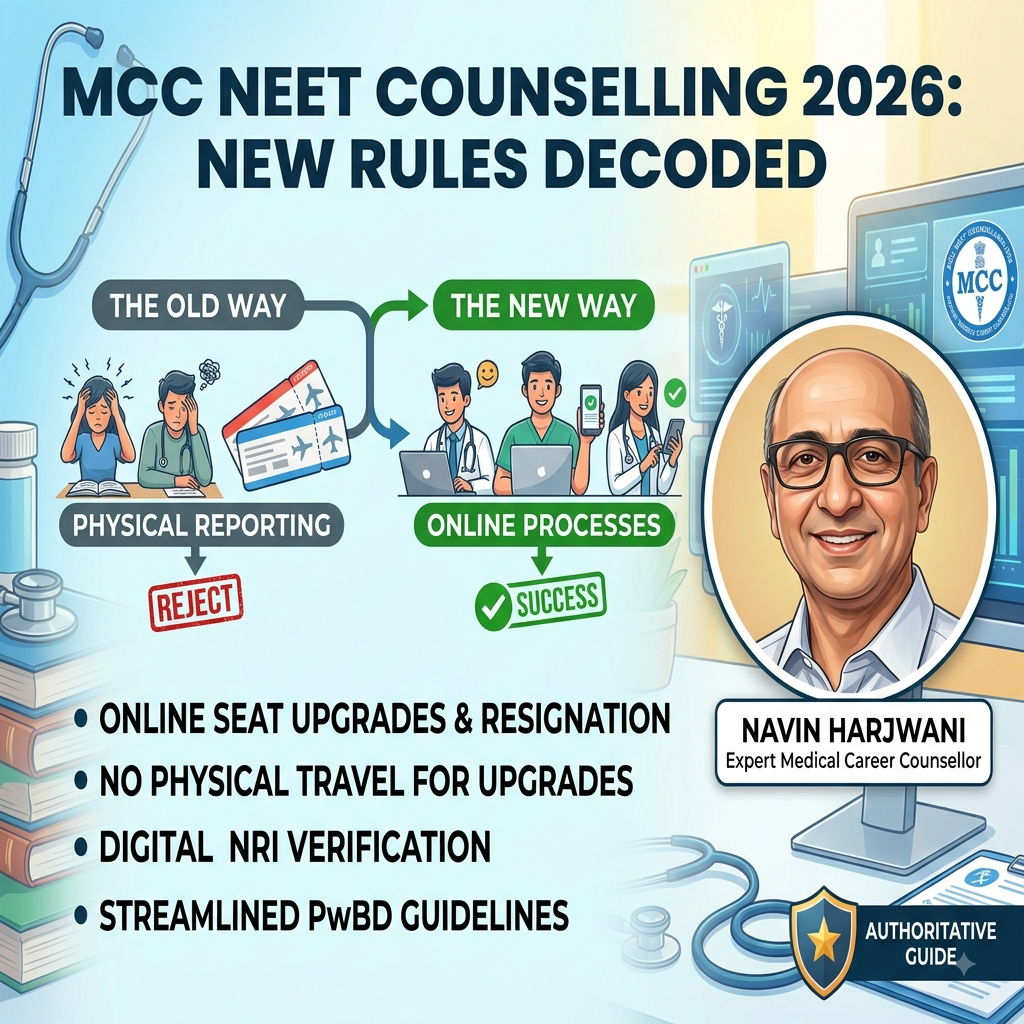
For quick reference, here are the four major updates to the 2026 MCC NEET UG and PG counselling process:
No Physical Reporting for Upgrades: You no longer need to travel to your allotted college just to complete admission formalities if you are opting for an "Upgrade" in the next round.
Online Seat Resignation: You can now surrender your allotted seat entirely online through the MCC portal within the stipulated timeline.
Digital Document Verification for NRI Quota: NRI and OCI candidates can now upload their required verification documents directly to the MCC portal.
Revised PwBD Guidelines: The NMC has updated the benchmark disability certification process to ensure uniform evaluation by designated disability assessment boards.
| Feature | The Old Process (Pre-2026) | The New 2026 Rule |
| Upgradation Process | Required traveling physically to the allotted college to secure the seat before opting for an upgrade in Round 2. | No physical visit required. Your seat is protected online while you participate in the next round. |
| Seat Resignation | Required physical travel to the allotted college to submit offline resignation documents and retrieve originals. | 100% Online. Resignations can be processed through the MCC portal within the specified deadline. |
| NRI Document Submission | Involved offline coordination and manual verification processes which were time-consuming. | Digital Upload. Documents are uploaded directly to the MCC portal for online verification by the NRI Document Verification Team. |
| Reporting for Final Admission | Multiple physical visits if you were upgrading across several rounds. | One-Time Physical Reporting. You only travel to the college physically after accepting your final, locked seat. |
As a counsellor who has facilitated thousands of successful admissions, I can confidently tell you that these changes were not made arbitrarily. The DGHS has designed these rules to solve very specific pain points for students and parents.
The Change: Eliminating physical reporting for seat upgradation.
Why it was made: India is vast. In the past, a student from Delhi allotted a seat in Tamil Nadu in Round 1 had to fly down, pay hotel fees, and physically report to the college just to say, "I want to upgrade in Round 2." This caused immense financial strain and exhaustion. By protecting the seat online, the MCC has saved candidates countless hours and thousands of rupees in travel costs.
The Change: Introducing an online resignation facility.
Why it was made: Previously, if a candidate wanted to resign a seat to join state counselling, they had to physically return to the college to process the paperwork. This often led to missed deadlines. The online resignation portal replaces this offline bottleneck, making the system highly efficient and ensuring that vacated seats are immediately fed back into the real-time seat matrix for other deserving candidates.
The Change: Direct digital uploads for NRI candidates.
Why it was made: NRI document verification was historically cumbersome. By moving this process online, the MCC ensures a centralized, organized, and transparent verification process before the choice-filling round even begins. This guarantees that only genuine, verified candidates can view and bid for NRI and Unreserved (UR) seats.
The Change: Revised PwBD assessment guidelines by the National Medical Commission (NMC).
Why it was made: To align with the Ministry of Social Justice and Empowerment, ensuring that disability evaluation norms are applied uniformly across all designated assessment boards. This eliminates discrepancies and ensures fair treatment for all candidates claiming PwBD quotas.
While the rules have become much more student-friendly, the competition and the strategic nature of choice-filling remain intense. Keep these three critical things in mind:
Protect Your Security Deposit: Students are required to pay a refundable security deposit during registration. However, if you do not understand the resignation rules or fail to join a seat allotted in later rounds, this deposit will be forfeited. In my 16 years of counselling, I have ensured my students navigate these rules carefully to secure their seats without losing their funds.
Respect the Deadlines: The MCC has made the process digital, but they are incredibly strict about deadlines. Whether it is choice locking (which is mandatory) or the window for online resignation, missing a cutoff by one minute can cost you a seat.
Choice Filling is a Strategy, Not a Wishlist: Arrange colleges strictly from most preferred to least preferred based on factual data like IPD/OPD footfall, bond conditions, and stipend details.
The 2026 MCC updates are a massive win for medical aspirants. Embrace the digital convenience, but stay vigilant with your strategy. If you need personalized guidance on profiling, choice preferences, or ensuring your documents are flawless, my team and I are here to help.