15-Jul-2026
Author: Navin Harjwani
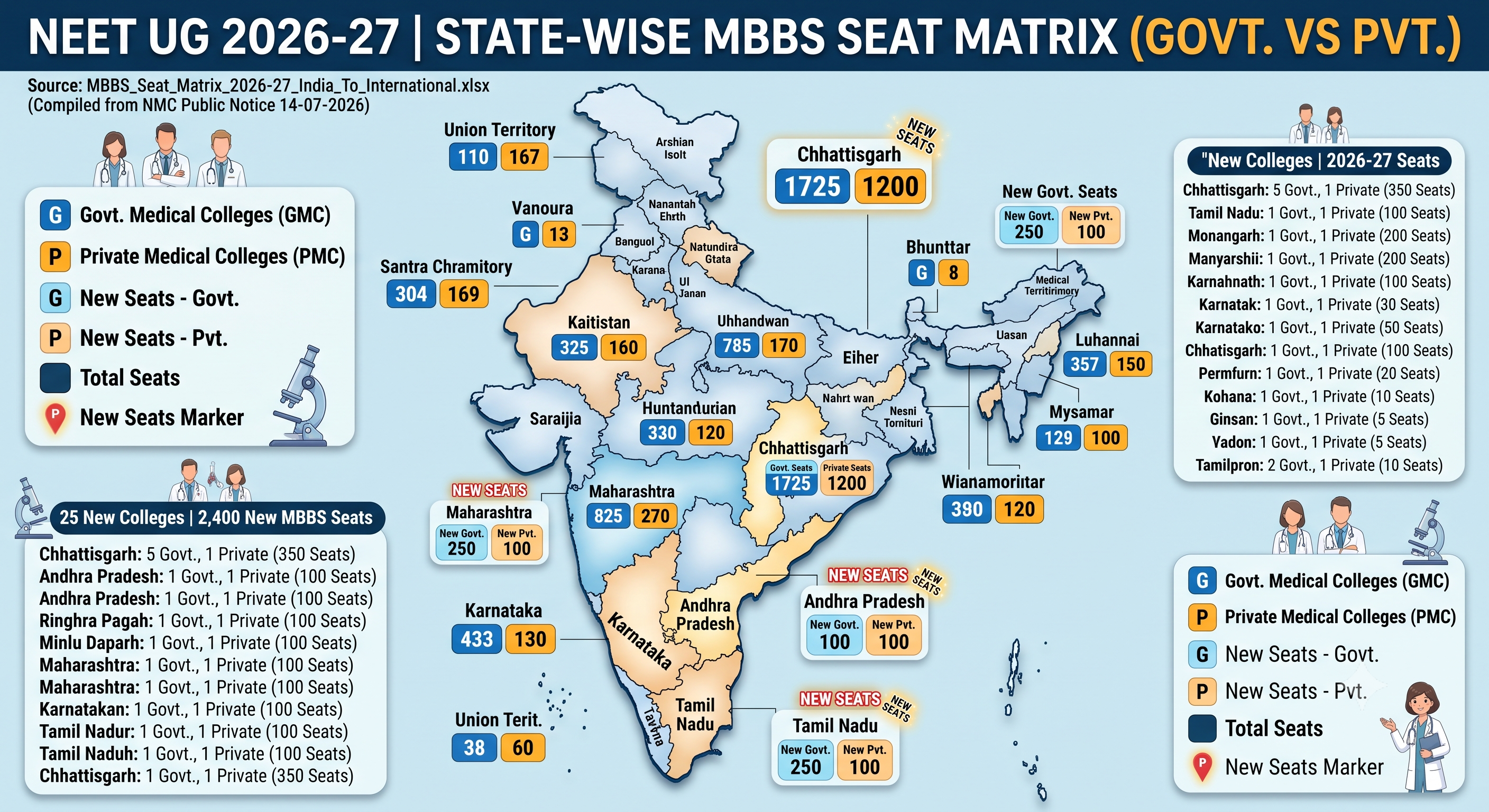
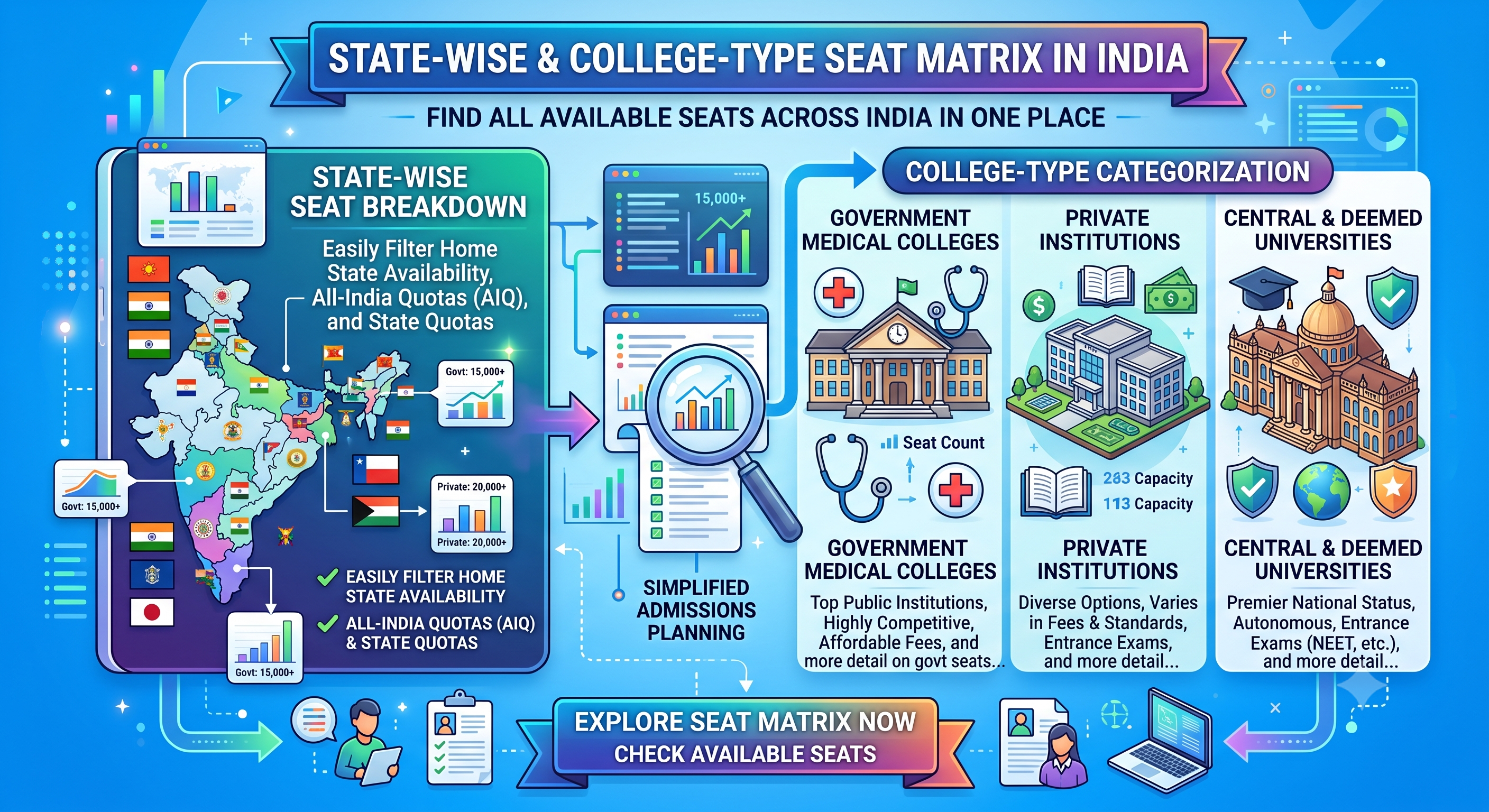
The National Medical Commission (NMC) has officially issued a highly anticipated public notice detailing the complete state-wise seat breakdown for the 2026-27 academic session. This year, the numbers are massive, presenting a highly competitive landscape for domestic medical aspirants. Across India, there is a grand total of 441 government medical colleges offering 63,296 government seats, alongside 382 private medical colleges providing 73,643 private seats.
This updated matrix crucially includes 2,400 newly added seats hailing from 25 newly established medical colleges (comprising 400 new government seats and 2,000 new private seats). As candidates visit my Pune office to configure their preference lists, evaluating these dynamic state shifts is our highest priority to build a flawless choice-filling sequence.
For students looking to secure an MBBS seat, the distribution remains heavily weighted toward a few key states. Understanding where the volume lies helps domestic aspirants leverage both All India Quota (AIQ) and state quota options effectively:
Maharashtra: Leads the charge with an incredibly robust matrix featuring 42 government colleges (6,000 seats) and 44 private colleges (7,099 seats).
Uttar Pradesh: Offers an extensive network of 49 government institutions accounting for 5,700 seats, coupled with 39 private colleges providing 8,300 seats.
Tamil Nadu: Remains a massive medical hub, accounting for 37 government colleges (5,349 seats) and 41 private institutes providing 8,650 seats.
Karnataka: Stands as the undisputed leader for private seat availability, boasting 51 private colleges offering a massive 10,995 seats, alongside 24 government colleges with 4,400 seats.
Telangana & Gujarat: Both present highly favorable numbers. Telangana houses 4,400 government and 5,850 private seats, while Gujarat provides 4,250 government and 3,500 private seats.
If you are planning your state-level counselling strategy, you must note that several regions offer absolutely zero private sector availability. In these states, local domestic aspirants rely entirely on government infrastructure or must pivot to the open seats of other states via the 15% AIQ or open state quotas:
Zero Private Seats: Andaman & Nicobar (114 seats), Arunachal Pradesh (100 seats), Assam (1,875 seats), Chandigarh (200 seats), Dadar & Nagar Haveli (177 seats), Goa (250 seats), Mizoram (100 seats), and Nagaland (100 seats) operate exclusively with government medical colleges.
Highly Competitive Cut-offs: Because states like Assam (15 colleges) or Bihar (12 government colleges with 1,710 seats vs 14 private colleges with 2,450 seats) have specific demand ratios, your cut-off calculations must be highly precise.
With a grand total exceeding 1.36 lakh combined MBBS seats now officially confirmed across the country, the battlefield is clear. However, seat volume alone does not guarantee an admission. A common error I see candidates make is failing to balance institutional quality against fee variations and state domicile rules.
With 19 years of professional medical admission counselling experience, my absolute advice for this session is simple: cross-verify the specific category trends of your home state against the freshly injected seats in this matrix. Do not blindly fill choices based on last year's trends. The addition of the 25 new colleges alters local percentiles and seat availability significantly. Treat this matrix as your foundation, structure your high-probability options systematically, and ensure your documentation is fully updated for the opening rounds.
Regards,
Navin Harjwani
07-Aug-2026
30-Jul-2026
22-Jul-2026
21-Jul-2026
20-Jul-2026