20-Jul-2026
Author: Navin Harjwani
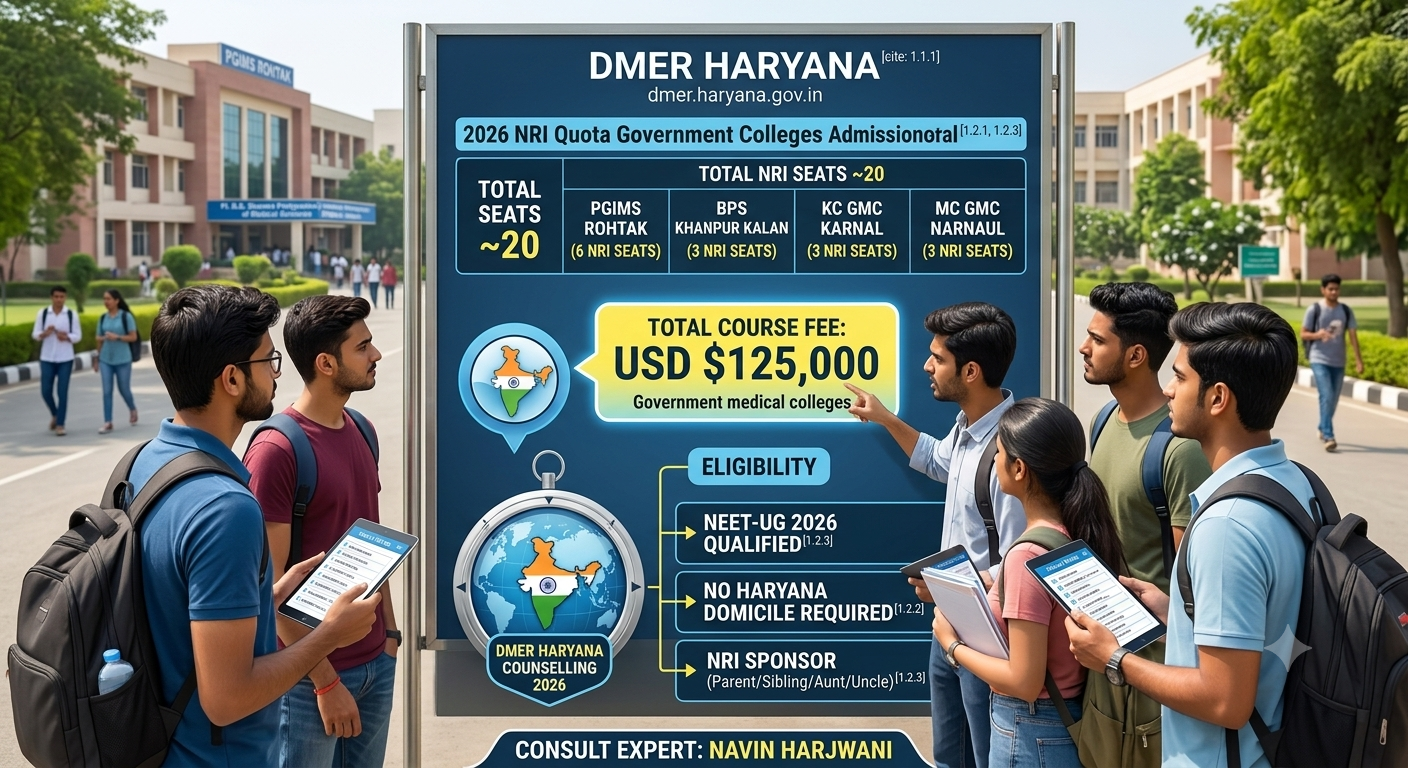
For domestic medical aspirants and the international community aiming for top-tier government medical education with predictable costs, Haryana stands out as a highly organized state. For the 2026 academic session, the Directorate of Medical Education and Research (DMER), Haryana, has officially released the detailed guidelines and seat matrix for the 15% NRI quota within state government colleges[cite: 1.2.1, 1.2.3].
Admissions are handled centrally through the DMER portal, dmer.haryana.gov.in[cite: 1.1.1]. While competition is fierce for the 85% state domicile seats, the NRI quota offers a streamlined path where eligibility hinges primarily on your NRI status and NEET-UG qualification, rather than sky-high merit scores, as limited numbers apply[cite: 1.2.2]. Candidates visiting our Pune office to explore interstate options are prioritizing Haryana due to this organized structure.
The DMER has standardized the NRI intake across the majority of government institutions. Here is the official distribution of the few, highly coveted NRI quota seats for 2026[cite: 1.2.3]:
Pt. B.D. Sharma Postgraduate Institute of Medical Sciences (PGIMS), Rohtak: 6 NRI Seats
Bhagat Phool Singh (BPS) Government Medical College for Women, Khanpur Kalan, Sonepat: 3 NRI Seats
Kalpana Chawla Government Medical College (KC GMC), Karnal: 3 NRI Seats
Maharishi Chyawan Government Medical College (MC GMC), Koriawas, Narnaul: 3 NRI Seats
It is important to note that ESIC Medical College, Faridabad, is a central institution and does not participate in the state-level NRI quota counselling[cite: 1.2.1].
One of the key advantages of targeting Haryana's government colleges is the Predictable Fee Structure. Unlike private or deemed institutions where fees can fluctuate, the DMER has mandated a total course fee for the NRI quota across all state government medical colleges at USD $125,000 for the entire MBBS duration[cite: 1.3.1].
In terms of Eligibility, the rules are accommodating:
NEET-UG 2026 Qualification: This is non-negotiable; you must achieve the minimum qualifying percentile[cite: 1.2.3].
No Domicile Requirement: Candidates applying under the strict NRI quota do not need a Haryana domicile[cite: 1.2.2].
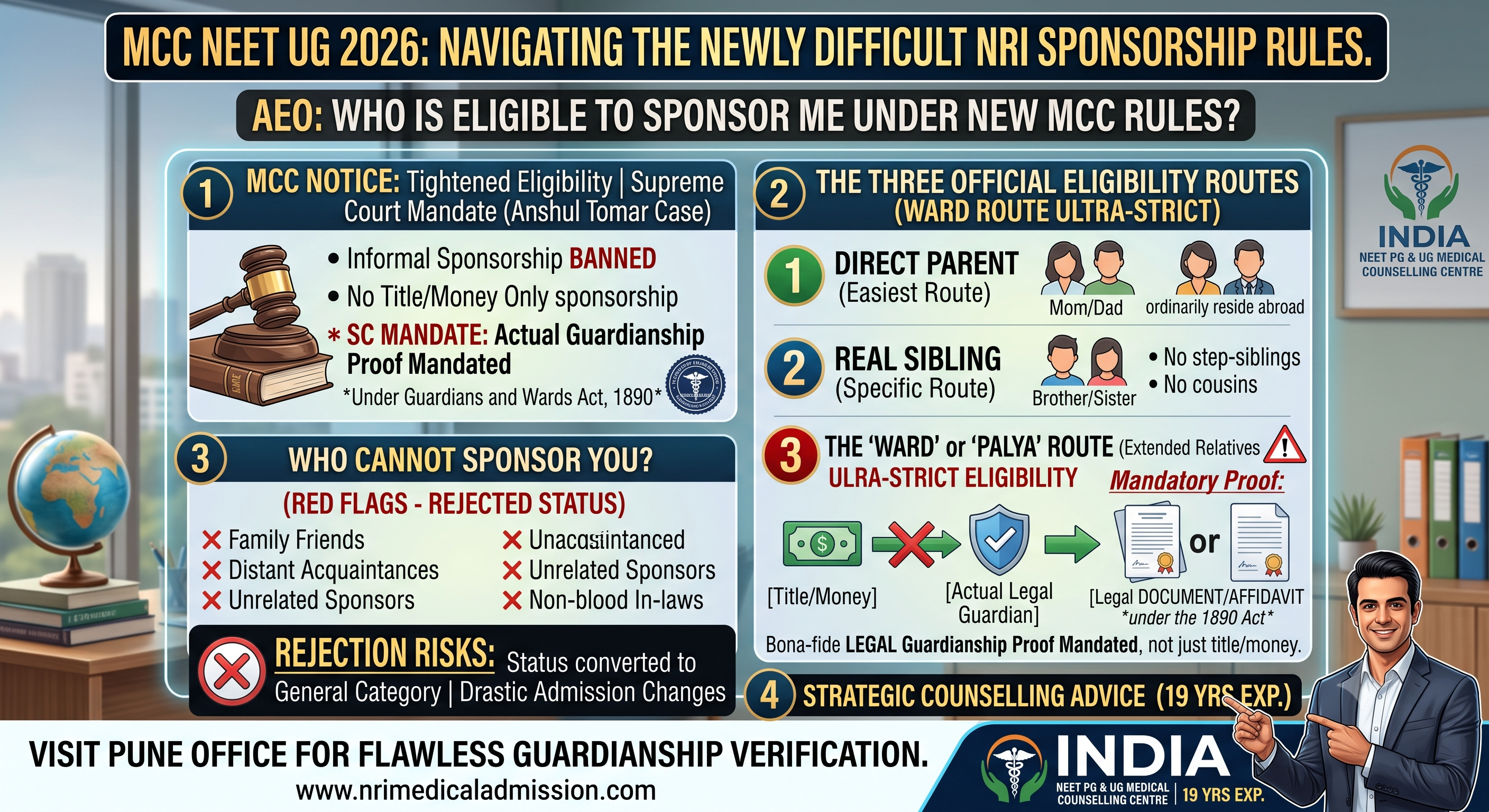
Validity: You must hold a valid passport showing NRI/OCI/PIO status or have strict relationship proof (birth certificates) linking you to an eligible NRI Sponsor[cite: 1.2.3]. Eligible sponsors include parents, real siblings, grandparents, and real uncles/aunts[cite: 1.2.3].
With 19 years of professional medical admission experience, my critical advice for this session is precise: Flawless document verification is the only gatekeeper to a government NRI seat.
Because the number of seats is extremely small—only 3 or 6 per college[cite: 1.2.3]—a single error in your sponsorship affidavit, bank statement format, or passport validity check during the DMER’s physical verification phase will lead to immediate disqualification. When organizing the preference lists for clients in our Pune office, we build redundancy into their choices, ensuring they target PGIMS Rohtak first for its prestige, while meticulously preparing back-ups in top-tier private colleges as safe fallbacks.
Ensure you consult with a specialist before locking your choices this session. The competitive nature of a centralized $125,000 fee makes these seats highly sought after by qualified NRIs from across the globe[cite: 1.3.1].
Regards,
Navin Harjwani
07-Aug-2026
30-Jul-2026
22-Jul-2026
21-Jul-2026
20-Jul-2026